Dog violet
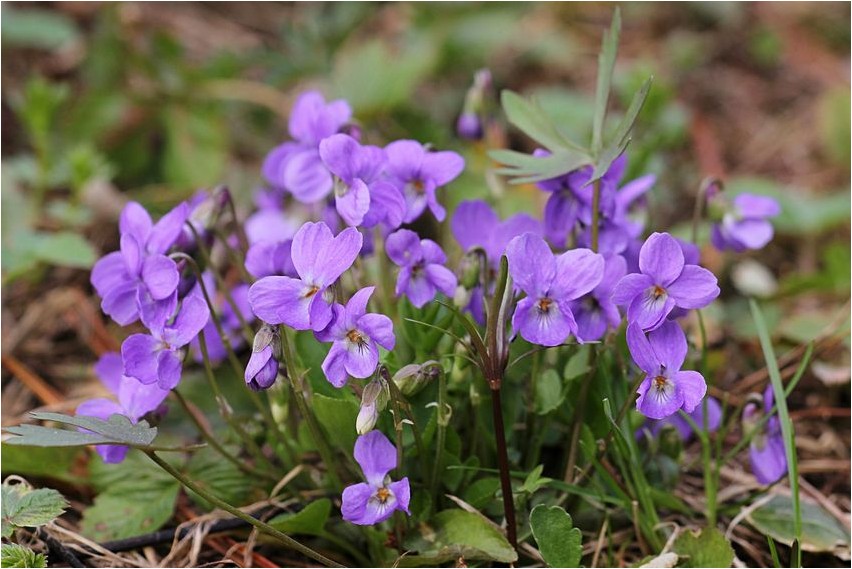
Dog violet (lat. Viola canina) is a herbaceous rhizomatous perennial plant of the genus Violet (lat. Viola) of the same name family Viola (lat.
Violaceae). The blooming of light blue-violet flowers from April to June may also please dogs, but they cannot tell about it. Although botanists gave this specific epithet to the plant not because of a dog’s love for delicate flowers, but for a completely different reason. The plant is used in cultural horticulture. The herb and roots of Canine Violet have healing powers.
What’s in your name
The dog violet does not change the tradition of the genus, coloring the delicate petals of the flowers in purple tones. After all, the Latin word “Viola” means “purple”.
The specific epithet “canina”, which is translated from Latin as “dog”, was assigned to this species not for the canine love of the plant, nor for its external resemblance to similar living creatures, but because when botanists first began to describe this species of Violet, for some reason they classified it as useless plants growing wild. When we figured out the plant, having learned about its abilities, we realized that we had unfairly offended the graceful and gentle Violet, which also has healing abilities, but the old name remained with the plant.
Description
The guarantee of the longevity of Canine Violet is its short, thin rhizome with a dense network of adventitious roots. During the winter, the above-ground part of the plant dies off, and renewal buds remain on the rhizome, located at the soil levels, from which new stems are reborn in early spring.
Unlike many species of the Violet genus, which do not have a stem, and the leaves grow directly from the rhizome, forming a basal rosette, in the Canine Violet, numerous leafy stems emerge from the rhizome to the surface of the ground, the number of which can be from 5 to 12 pieces. The stems are ascending, low-growing, forming an independent ground cover clump. The stems can be bare or covered with light pubescence.

Along the length of the stem are petiolate leaves, which are either bare or have slight pubescence at the base of the leaf blade. The leaves located in the middle part of the stem are equipped with lanceolate stipules. The shape of the leaf blade is lanceolate to ovate-cordate with small teeth along the edge.
In May-June, 5-petalled flowers are born in the axils of the leaves on long stalks. They are traditionally irregular in shape, bisexual, the lower petal of the flower has a spur. The color of the petals is light blue or light purple, with a white throat and five yellow stamens surrounding a single-locular ovary. Blooming may occur again in late summer.
The crown of the growing season is the fruit – the seed capsule. When the seeds are fully ripe, the three flaps of the capsule crack, releasing the seeds around the mother plant within a radius of one meter. Further transportation of seeds is carried out by ants.
Curtains of Canine Violet are an indicator of acidic soil.
Usage
Although the chemical composition of Canine Violet has been little studied, traditional healers have long used the roots and herbs of the plant to treat a number of human ailments.
As centuries-old experience has shown, Canine Violet, like its many relatives, can help people when they need pain relief, counteract the inflammatory process, relieve coughs, and aid digestion. Canine violet is used in the form of herbal infusions and preparations from the roots of the plant.
Delicate spring blooms will decorate any type of flower garden. Low-growing bushes will fit harmoniously into a rocky hill, serve as the foreground of a mixborder, or become a picturesque border of a garden path.





