Lavatera
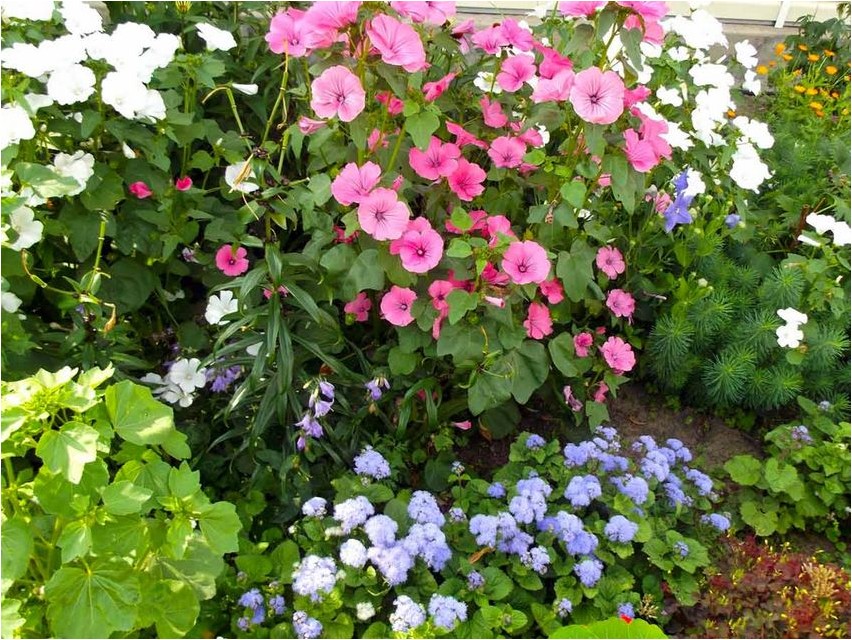
Lavatera (lat. Lavatera) – flower culture; annual or perennial plant of the Malvaceae family. Under natural conditions, lavatera grows in Central Asia, the Mediterranean, western North America and some European countries.
The second name is khatma. Currently there are about 25 species. In Russia, only 4 species are widespread.
Characteristics of culture
Lavatera is a herbaceous plant with a strong, erect, branched, pubescent stem 60-120 cm high. The lower leaves are petiolate, heart-shaped or round, green, arranged alternately, the upper leaves are angular or five-lobed.
The flowers are large, axillary, solitary, funnel-shaped, reaching 6-10 cm in diameter, collected in racemose-paniculate inflorescences. The upper flowers are located on short peduncles, the lower ones – on long ones. The corolla is five-petalled and can be yellow, white, pink, coral or purple. Petals are notched, obovate. Flowering is abundant and long lasting, lasting from July until frost.
The fruit is a composite, consisting of a large number of kidney-shaped or rounded single-seeded mericarps, which are arranged in the form of a regularly shaped ring surrounding a conical or umbellate column. The seeds are brown-brown in color, round, with a rough surface. Seed germination lasts 4-5 years. The seeds ripen in August – September.

Growing conditions
Lavatera is a light-loving plant, prefers well-lit areas protected from cold winds. The crop is not demanding on soil conditions, but develops best in light, well-drained and fertile soils. Lavater has a negative attitude towards excessive humidity and does not tolerate fertilizing with fresh organic fertilizers.
Reproduction and sowing
Lavatera is propagated by seeds. Sowing of seedlings is carried out in late March – early April, sowing in open ground – in mid-May. The crop blooms 2-2. 5 months after emergence, usually at the end of July, but lavatera grown through seedlings blooms 3-4 weeks earlier.
Care
Caring for lavatera is not difficult; it involves regular and moderate watering. Plants grown in poor soils need to be fertilized with mineral fertilizers. Tall lavatera varieties may require staking.
Faded flowers are removed. In August – September, seeds are collected; this procedure can extend the flowering period of the crop. Lavatera is often affected by rust, diseased specimens are removed and destroyed; no other methods have yet been invented to combat the disease.
Application
Lavatera is most often used for group and border plantings, to create high groups, mixed ridges and arrays on lawns. Lavatera is also suitable as hanging plants; it can be grown in pots, flowerpots and other containers. The plant is also used for cutting. Cut inflorescences retain their decorative effect for 5-8 days.
Common varieties
*Silver Cap (Silver Cap) – represented by plants reaching a height of 60-70 cm and forming compact bushes bearing large pink flowers with red veins.
*Pink Beauty – represented by plants reaching a height of 100 cm and forming compact bushes bearing large pale pink flowers with dark veins.
*Parade (Parade) – the variety is represented by plants reaching a height of 80 cm and forming compact bushes bearing medium pink-red or white flowers.
*Mont Blanc (Mont Blanc) – the variety is represented by plants reaching a height of 80 cm and forming compact bushes bearing large snow-white flowers.
*Twins Hot Pink (Twins Hot Pink) – the variety is represented by plants reaching a height of 40-45 cm and forming compact bushes bearing small bright pink flowers.





