Oxytropis deflexa
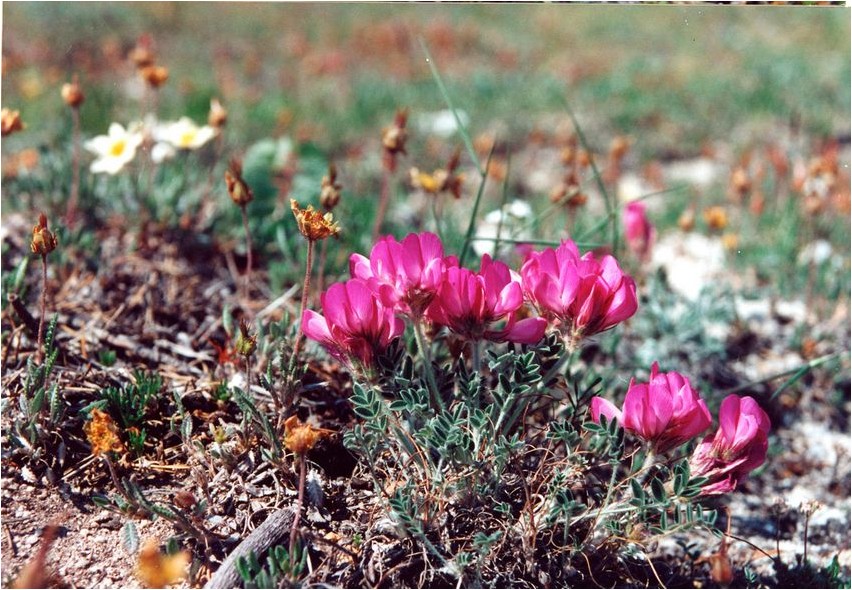
Oxytropis deflexa is a member of the legume family. Its Latin name is Oxytropis deflexa (Pall.) DC.
The Latin name for the Oxytropis deflexa family is Fabaceae Lindl. (Leguminosae Juss.).
Description of Oxytropis deflexa
Oxytropis deflexa is a perennial herbaceous plant with an ascending stem approximately twelve centimeters long. The plant is softly pubescent, with leaves ranging in length from five to twenty centimeters, and long-petiolate leaves. Fifteen to twenty paired leaflets are twenty millimeters long and three to five millimeters wide. These leaflets are grayish-green in color. The peduncles of the reclining oxytrope are approximately seven to twenty-five centimeters long, equal to or slightly longer than the leaves. The short, oval racemes are two to three centimeters long, dense and multi-flowered, with a corolla of pale bluish-purple tones. The flag of this plant is eight to nine millimeters long, with the wings being the same length, and the keels slightly shorter. The pods of the reclining oxytrope are ten to twenty millimeters long and four to five millimeters wide, with membranous pods.
Flowering of this plant begins in June and continues until July. In the wild, the reclining oxytrope is found in the Altai region of Western Siberia, the Far East, and Eastern Siberia in all areas, with the exception of the Yenisei region. In terms of general distribution, this plant is found in northwestern Mongolia. It prefers coastal gravel beds, meadows, and steppe valleys of mountain rivers.
Description of the medicinal properties of Oxytropis reclinata
Oxytropis reclinata has very valuable medicinal properties, and it is recommended to use the herb of this plant for medicinal purposes. The herb includes the flowers, stems, and leaves.
The presence of such valuable healing properties is recommended to be explained by the content of alkaloids, flavonoids, triterpene saponins, quercetin, campefrol and their glycosides in this plant. It is noteworthy that this plant is quite widespread in Tibetan medicine. An infusion and decoction prepared on the basis of the herb of the plant is recommended for use as an analgesic for toothache, and is also used for intoxication and septicopyemia.

For headaches, it is recommended to use the following remedy based on this plant: to prepare such a very effective healing remedy, it is recommended to take ten grams of crushed raw herb, tilted into one glass of water. The resulting mixture should be boiled for about three to four minutes, then this mixture is left to infuse for about two hours, after which it is recommended to strain this medicinal mixture based on this plant very carefully. Take the resulting medicinal product based on the sage plant three times a day before meals, one-third or one-fourth of a glass. It is noteworthy that this decoction can also be used for rinsing for toothache of varying degrees of intensity and duration.